Your Guide to Understanding and Accessing LDN in Maryland
If you're living with chronic pain, an autoimmune condition, fibromyalgia, or lingering Long COVID symptoms, you've probably heard whispers about low-dose naltrexone—or LDN for short. Maybe a friend mentioned it. Maybe you saw it discussed in an online support group. Maybe your doctor brought it up as a "might be worth trying" option.
Here's what makes LDN so interesting: it's an old drug being used in a completely new way. And for many people with conditions that don't respond well to traditional treatments, it's making a real difference.
But here's the catch—you can't just pick up LDN at any pharmacy. It requires compounding, which means it needs to be specially prepared by a pharmacy with expertise in custom medications. That's where we come in.
At WellPharma Pharmacy in Randallstown, we're one of the few USP 795-compliant compounding pharmacies serving Baltimore County and the greater Maryland area. We prepare low-dose naltrexone in precise, customized doses for patients throughout the region.
Let's break down everything you need to know about this increasingly popular treatment.
What Is Low-Dose Naltrexone and How Does It Work?
Naltrexone is an FDA-approved medication that's been around since the 1980s. At standard doses (50-100mg daily), it blocks opioid receptors in the brain and is used to treat alcohol and opioid addiction.
Low-dose naltrexone (LDN) is the same medication, but at much smaller doses—typically between 1.5mg and 4.5mg taken at bedtime. At these low doses, something fascinating happens: instead of blocking opioid receptors all day long, LDN blocks them temporarily for just a few hours while you sleep.
Here's why that matters:
When your body senses its opioid receptors are blocked, it responds by producing more of its own natural endorphins and enkephalins—your body's built-in pain relievers and mood regulators. This rebound effect happens while you sleep, and by morning, the naltrexone has worn off, leaving you with higher levels of your body's natural healing compounds.
Additionally, at low doses, LDN appears to:
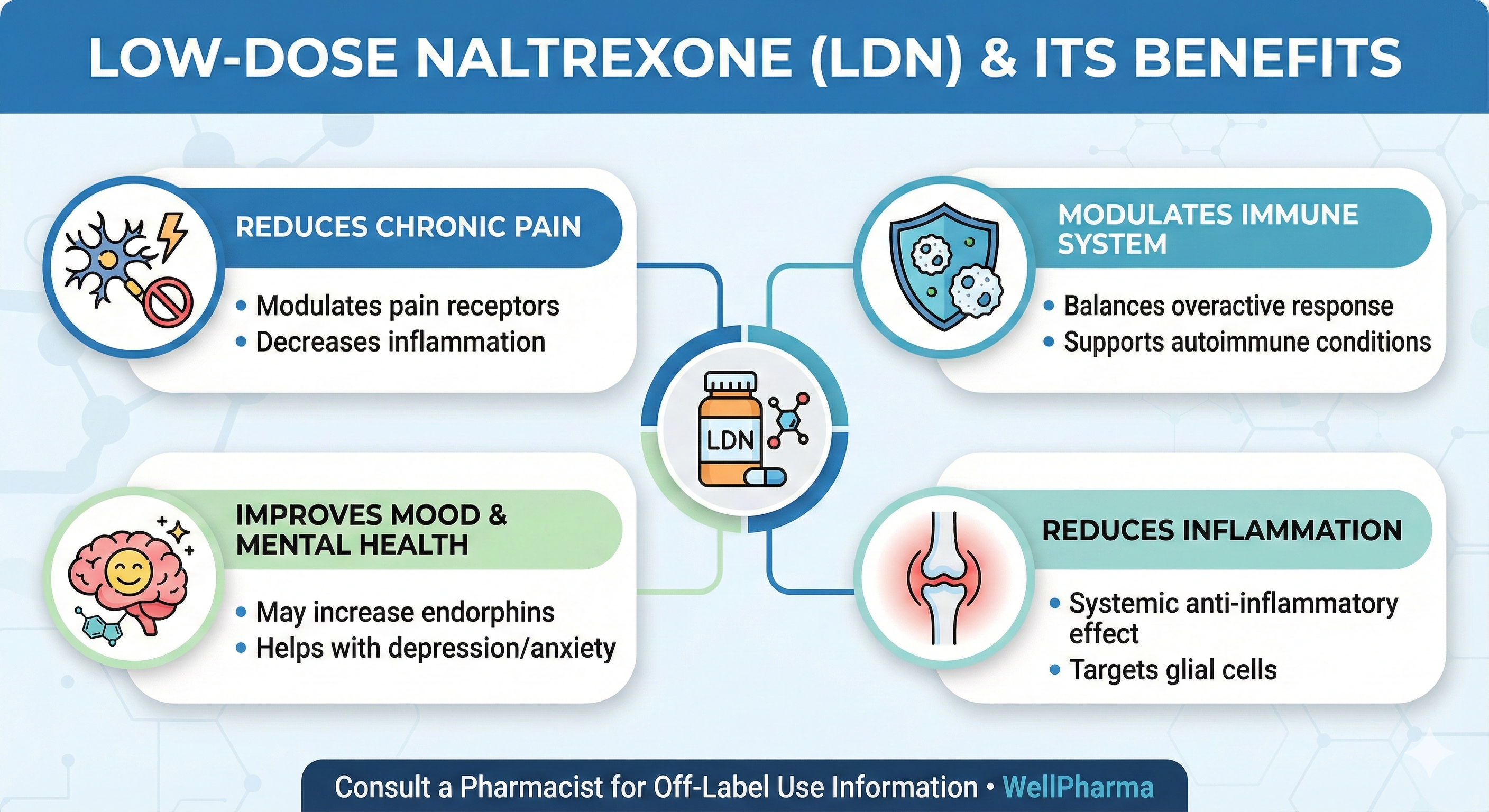
- Modulate immune system function - Helping calm overactive immune responses in autoimmune conditions
- Reduce inflammation - Particularly neuroinflammation (inflammation in the brain and nervous system)
- Decrease glial cell activation - Glial cells, when overactivated, contribute to chronic pain
- Support mitochondrial function - Improving cellular energy production
Think of it this way: Standard-dose naltrexone is like shutting down a highway. Low-dose naltrexone is like briefly slowing traffic to trigger a better flow pattern—your body responds by creating its own improved conditions.
Conditions LDN May Help
Low-dose naltrexone is used "off-label" (meaning for conditions beyond its original FDA approval) for a growing list of chronic conditions. While research is ongoing, both clinical studies and real-world patient data show promising results for:
Chronic Pain Conditions
Fibromyalgia
- Reduces pain intensity and fatigue
- Improves sleep quality
- Studies show 30-50% of fibromyalgia patients experience meaningful relief
- Works by reducing microglial activation in the central nervous system
Complex Regional Pain Syndrome (CRPS)
- May reduce nerve pain and inflammation
- Some patients report significant improvement in pain levels
General Chronic Pain
- Real-world data shows LDN users reduced opioid use by 46%
- Particularly helpful for pain that hasn't responded to other treatments
- Works differently than traditional pain medications
Autoimmune Conditions
Hashimoto's Thyroiditis
- Approximately 50% of patients report reduced symptoms
- May help with fatigue, brain fog, and joint pain associated with Hashimoto's
- Some patients see reduction in thyroid antibodies
Inflammatory Bowel Disease (Crohn's & Ulcerative Colitis)
- Studies show reduced inflammation markers
- May allow reduction in other disease-specific medications
- Helps manage pain and fatigue
Multiple Sclerosis (MS)
- Some studies show reduced fatigue and improved quality of life
- May help with neuropathic pain
- Generally well-tolerated alongside MS medications
Rheumatoid Arthritis
- May reduce joint pain and inflammation
- Some patients able to reduce NSAID use
- Anti-inflammatory effects support joint health
Post-Viral and Fatigue Syndromes
Long COVID
Major NIH RECOVER research program actively studying LDN for Long COVID
Recent patient surveys show:
- 41.5% improvement in fatigue/low energy
- 33.2% improvement in post-exertional malaise
- 42.3% improvement in brain fog
Nearly 50% of Long COVID patients in surveys report using LDN
Myalgic Encephalomyelitis/Chronic Fatigue Syndrome (ME/CFS)
- Addresses core symptoms: fatigue, post-exertional malaise, cognitive issues
- Helps some patients regain functional capacity
- Works by reducing neuroinflammation
Other Conditions
Autoimmune Skin Conditions
- Alopecia (autoimmune hair loss)
- Psoriasis
- Eczema with autoimmune component
Neuropathic Pain
- Diabetic neuropathy
- Post-herpetic neuralgia (shingles pain)
- Chemotherapy-induced neuropathy
Important note: LDN doesn't work for everyone, and response is highly individual. Research suggests about 50% of patients experience meaningful benefit, while the other 50% see little to no improvement. The only way to know if it will help you is to try it under medical supervision.
The Science Behind LDN: Why Low Doses Work Differently
This is where LDN gets really interesting from a scientific perspective.
The Opioid Growth Factor (OGF) Pathway
At low doses, naltrexone works through a completely different mechanism than at high doses:
High-dose naltrexone (50mg+): Blocks opioid receptors continuously, preventing euphoria from opioids or alcohol.
Low-dose naltrexone (1.5-4.5mg): Temporarily blocks opioid receptors for 3-4 hours, triggering a compensatory increase in:
- Endorphins (natural pain relief)
- Enkephalins (mood regulation)
- Opioid growth factor receptors (cellular healing)
This temporary blockade essentially "exercises" your endorphin system, making it stronger and more responsive.
Immune System Modulation
LDN affects immune function in several ways:
- Reduces pro-inflammatory cytokines - Chemical messengers that promote inflammation
- Balances Th1/Th2 immune response - Helps correct autoimmune imbalances
- Decreases microglial activation - Calms overactive immune cells in the nervous system
- Supports regulatory T-cells - Cells that help prevent autoimmune attacks
The Timing Matters
LDN is typically taken at bedtime because:
- Endorphin production naturally peaks between 2-4 AM
- The temporary blockade during sleep triggers maximum rebound effect
- You sleep through any mild initial side effects
- By morning, naltrexone has cleared but benefits remain
Some patients find they sleep better taking it in the morning—there's flexibility here, and your compounding pharmacist can help you determine the best timing for your body.
How to Get Started with LDN
Getting LDN involves several steps, but the process is straightforward once you understand it:
Step 1: Find a Prescriber
This is often the hardest part. You need a doctor, nurse practitioner, or physician assistant who:
- Is familiar with LDN and comfortable prescribing it off-label
- Understands your condition and medical history
- Will monitor your progress
Types of providers most likely to prescribe LDN:
- Functional medicine doctors
- Integrative medicine practitioners
- Pain management specialists
- Rheumatologists (for autoimmune conditions)
- Some primary care doctors
- Naturopathic doctors (in states where they can prescribe)
What to bring to your appointment:
- Your medical history and current medications
- Research articles about LDN for your specific condition
- Explanation that LDN requires compounding
- Name of a compounding pharmacy (WellPharma!)
If your current doctor isn't familiar with LDN, you can share information from the LDN Research Trust (ldnresearchtrust.org) or ask for a referral to someone who prescribes it.
Step 2: Get the Right Prescription
A proper LDN prescription should specify:
- Starting dose (typically 1.5mg)
- Target dose (typically 3.0-4.5mg)
- Titration schedule (how quickly to increase)
- Dosage form (usually capsules, sometimes liquid)
- "Dispense as written" or "Compounding required" (so it's not substituted)
- Compounding pharmacy (ideally sent directly to WellPharma)
Step 3: Work with a Compounding Pharmacy
This is critical: LDN cannot be made from commercially available naltrexone tablets. Why?
- Commercial naltrexone comes in 50mg tablets
- LDN doses are 1.5-4.5mg (10-30 times smaller)
- Cutting a 50mg tablet won't give accurate low doses
- Commercial tablets contain fillers that may interfere with low-dose effects
- Precise dosing requires pharmaceutical-grade compounding
At WellPharma Pharmacy, our compounding process includes:
✅ USP 795 compliance - Following strict pharmaceutical compounding standards
✅ Pharmaceutical-grade naltrexone - Pure active ingredient from FDA-registered facilities
✅ Precise measuring and mixing - Accurate to within 0.1mg
✅ Quality control testing - Verifying potency and purity
✅ Custom dosing - Exact doses for your titration schedule
✅ Filler selection - We avoid common allergens and use fillers that don't interfere with absorption
✅ State-of-the-art equipment - Ensuring consistency batch to batch
We prepare LDN in capsule form (most common) or as a liquid suspension (for patients who can't swallow capsules or need ultra-precise dose adjustments).
What to Expect: Dosing, Timeline, and Side Effects
Standard LDN Dosing Protocol
Week 1-2: Start at 1.5mg
- Take at bedtime
- Monitor for any side effects
- Give your body time to adjust
Week 3-4: Increase to 3.0mg
- If tolerating 1.5mg well
- Some patients feel best at this dose and stay here
Week 5-6: Increase to 4.5mg
- The most common maintenance dose
- Where most people see maximum benefit
Note: This is a general guideline. Your doctor may recommend a different schedule, and that's fine. Some people do better on lower doses (even 1.5mg long-term), while others need to go slightly higher.
Timeline for Results
Patience is key with LDN. This isn't a medication that works overnight.
Weeks 1-4:
- Side effects (if any) typically occur here
- Most people don't notice benefits yet
- Some feel slightly worse initially (temporary)
Weeks 4-8:
- Side effects usually resolve
- Early benefits may start appearing
- Subtle improvements in energy or pain
Months 2-3:
- More noticeable improvements
- Many people reach stable benefit here
- Some conditions take longer
Months 3-6:
- Maximum benefit typically achieved
- Clearer sense of whether LDN is helping
- Effects may continue improving
The bottom line: Give LDN at least 2-3 months before deciding if it's working. Some people see benefits sooner, but many don't notice significant changes until month 2 or 3.
Common Side Effects (and How to Manage Them)
LDN is generally very well-tolerated. In large studies of over 11,000 patients, no serious adverse events were reported at low doses.
However, about 50% of people experience mild, temporary side effects, usually in the first 2-4 weeks:
Vivid Dreams or Sleep Disturbances
- Most common side effect
- Dreams may be more colorful or memorable
- Usually resolves within 2-3 weeks
- Management: Try taking in the morning instead, or reduce dose temporarily
Insomnia
- Difficulty falling or staying asleep
- Often temporary
- Management: Switch to morning dosing, reduce dose, or try 3mg instead of 4.5mg
Nausea
- Usually mild and transient
- More common when starting or increasing dose
- Management: Take with food, increase dose more slowly, ginger tea can help
Headaches
- Typically mild
- Often resolve as body adjusts
- Management: Stay hydrated, take with food, reduce dose if persistent
Fatigue
- Some people feel more tired initially
- Usually improves after 2-3 weeks
- Management: Be patient, ensure adequate sleep, consider morning dosing
Most side effects resolve on their own or with simple adjustments. If side effects are bothersome, don't give up—talk to your doctor and pharmacist about modifying your dose or timing.
Important Contraindications
Do NOT take LDN if you:
- Are currently taking opioid pain medications (LDN blocks their effects)
- Are pregnant or breastfeeding (insufficient safety data)
- Have severe liver disease (naltrexone is processed by the liver)
Use with caution if you have:
- Current acute hepatitis (liver inflammation)
- History of substance use disorder (discuss thoroughly with doctor first)
Always tell your doctor about all medications and supplements you're taking.
Why LDN Requires a Compounding Pharmacy
You might wonder: "Why can't I just get this at CVS or Walgreens?"
Great question. Here's why LDN requires specialized compounding:
The Dose Problem
- Commercial naltrexone: 50mg tablets
- LDN doses: 1.5mg, 3mg, 4.5mg
- The math: You'd need to cut a 50mg tablet into 11-33 pieces for accurate dosing—impossible
The Precision Problem
Even if you could cut tablets that small:
- Tablets aren't uniformly mixed (active ingredient isn't evenly distributed)
- Commercial tablets contain coatings and fillers
- You can't guarantee dose accuracy
- Small variations in LDN doses can significantly affect response
The Formulation Problem
Commercial 50mg naltrexone tablets are formulated for immediate, complete absorption. LDN often works better with specific formulations:
- Immediate-release for standard use
- Slow-release for some patients (smooths out effects)
- Filler selection matters - Some fillers interfere with low-dose effectiveness
The Quality Control Problem
Compounding pharmacies follow strict standards:
- USP Chapter 795 for non-sterile compounding
- Beyond-use dating ensuring stability
- Potency testing verifying accurate dosing
- Contamination prevention through proper technique
- Ingredient verification using pharmaceutical-grade sources
At WellPharma Pharmacy:
We're not just crushing up tablets. We're creating precision medicine from pharmaceutical-grade naltrexone powder, measured to exacting standards, mixed with carefully selected fillers, and prepared in our USP 795-compliant compounding lab.
Each batch is documented, tested, and prepared following the same rigorous standards as commercial pharmaceuticals. The difference? Ours is customized specifically for your prescribed dose.
Getting LDN in Maryland: Your Step-by-Step Guide
Your WellPharma LDN Journey
Step 1: Get Your Prescription
Work with your doctor to get a prescription for low-dose naltrexone. Have them send it directly to:
WellPharma Pharmacy
9818 Liberty Rd, Suite B
Randallstown, MD 21133
Phone: (410) 698-9068
Fax: (if sending prescription)
Or, bring your written prescription to us in person.
Step 2: Initial Pharmacist Consultation
When we receive your prescription, Dr. Zahraa Babiker, PharmD, or one of our compounding pharmacists will:
✅ Review your medical history and current medications
✅ Discuss your condition and treatment goals
✅ Explain the titration schedule
✅ Review potential side effects and how to manage them
✅ Determine the best dosage form for you (capsules or liquid)
✅ Answer all your questions
This consultation is complimentary and ensures you start LDN safely and effectively.
Step 3: Custom Compounding
We'll compound your LDN in our state-of-the-art lab:
- Precise measuring of pharmaceutical-grade naltrexone
- Careful mixing with appropriate fillers
- Encapsulation in your prescribed doses
- Quality control verification
- Proper labeling with all instructions
Typical turnaround time: 24-48 hours (we compound fresh batches regularly)
Step 4: Medication Pickup and Education
When you pick up your LDN:
- We'll review proper storage (room temperature, away from light)
- Explain when and how to take it
- Provide written information
- Schedule follow-up check-ins
- Give you our direct line for questions
Step 5: Ongoing Support
We're here for the long term:
- Monthly refills (we'll remind you)
- Check-ins to see how you're doing
- Dose adjustments as needed per your doctor's guidance
- Troubleshooting any issues
- Communication with your prescriber if needed
Cost and Insurance
Typical LDN cost at WellPharma:
- One month supply: $45-50 (depending on dose)
- Three month supply: Usually slight discount for bulk compounding
Insurance coverage:
- Most insurance plans don't cover compounded LDN (it's off-label)
- However: We can provide itemized receipts for FSA/HSA accounts
- Some patients submit claims for reimbursement (success varies)
- We can check your specific plan if you'd like
Cost comparison:
- Many prescription medications for chronic conditions cost $50-500+ per month
- LDN is significantly more affordable than most alternatives
- No prior authorization hassles
- No insurance denials or limitations
For many patients, the out-of-pocket cost is worth it for a medication that may reduce or eliminate the need for more expensive treatments.
Serving Maryland Communities
WellPharma Pharmacy is proud to serve patients throughout:
- Randallstown
- Owings Mills
- Pikesville
- Reisterstown
- Catonsville
- Columbia
- Ellicott City
- Towson
- Baltimore City
- All of Baltimore County
- And beyond!
We also offer free local delivery for seniors and patients with mobility challenges. Call us to arrange delivery service.
Real Patient Questions About LDN
Q: How long will I need to take LDN?
A: Many people take LDN long-term (years) as it works by supporting ongoing immune and pain regulation. It's not a "cure," but rather ongoing support. However, some people find they can reduce or stop after their condition improves. Always discuss with your doctor.
Q: Can I take LDN with my other medications?
A: LDN has very few drug interactions. The main exception is opioid pain medications—LDN will block their effects. Always review your full medication list with your pharmacist and doctor.
Q: What if I miss a dose?
A: Just take your next scheduled dose. Don't double up. LDN's benefits are cumulative, so one missed dose won't undo your progress.
Q: Can I drink alcohol while taking LDN?
A: Moderate alcohol consumption is generally fine with LDN (unlike high-dose naltrexone used for alcohol use disorder). However, some people find alcohol affects them differently on LDN. Use caution and moderation.
Q: Will LDN interact with supplements?
A: Generally no. LDN works well alongside most supplements. However, always inform your pharmacist of everything you're taking.
Q: What if I don't notice any improvement after 3 months?
A: Talk to your doctor about trying a different dose (some people respond better to 3mg than 4.5mg, or vice versa) or discontinuing if there's clearly no benefit. LDN isn't for everyone.
Q: Is LDN addictive?
A: No. LDN is not addictive and has no potential for abuse or dependence.
Q: Can I stop LDN suddenly?
A: Yes. Unlike many medications, LDN can be stopped without tapering. However, symptoms it was helping may gradually return.
The Future of LDN Research
Exciting developments are happening in LDN research:
Ongoing Clinical Trials:
- NIH RECOVER program studying LDN for Long COVID
- Multiple university studies on autoimmune conditions
- Fibromyalgia and ME/CFS research expanding
- Cancer-related fatigue and pain studies
What's Being Discovered:
- Better understanding of immune modulation mechanisms
- Identification of patient types most likely to respond
- Optimal dosing strategies for different conditions
- Combination therapies that work synergistically with LDN
As research progresses, we expect LDN to gain more mainstream acceptance and potentially even FDA approval for specific conditions beyond addiction treatment.
Is LDN Right for You?
Low-dose naltrexone may be worth considering if:
✅ You have a chronic condition that hasn't responded well to standard treatments
✅ You're looking for a medication with minimal side effects
✅ You're interested in supporting your body's natural healing mechanisms
✅ You're willing to be patient (results take 2-3 months)
✅ You have a prescriber willing to try it
✅ You're able to afford ~$40/month out-of-pocket
LDN is NOT a miracle cure, but for the right patients with the right conditions, it can be genuinely life-changing.
Next Steps: Starting Your LDN Journey
Ready to explore LDN?
1. Talk to Your Doctor
- Discuss whether LDN is appropriate for your condition
- Get a prescription if your doctor agrees
- Have the prescription sent to WellPharma
2. Contact WellPharma Pharmacy
- Call (410) 698-9068
- Ask to speak with one of our compounding pharmacists
- Schedule your initial LDN consultation
- We'll answer all your questions
3. Get Started
- Pick up your custom-compounded LDN
- Follow your titration schedule
- Keep a symptom journal to track progress
- Stay in touch with us and your doctor
4. Be Patient and Consistent
- Take LDN daily as prescribed
- Give it at least 2-3 months
- Report any concerns to your pharmacist or doctor
- Adjust as needed based on your response
Your Maryland LDN Compounding Experts
At WellPharma Pharmacy, we're passionate about helping patients access medications that can truly make a difference—even when those medications require specialized preparation.
Our compounding pharmacists have:
- Extensive training in USP 795 standards
- Years of experience preparing LDN
- Deep knowledge of chronic conditions LDN treats
- Commitment to pharmaceutical-grade quality
- Genuine care for patient outcomes
We serve patients with:
- Fibromyalgia
- Autoimmune conditions
- Chronic pain syndromes
- Long COVID and ME/CFS
- And many other chronic conditions
Whether you're just learning about LDN or you're ready to start, we're here to support you every step of the way.
WellPharma Pharmacy
9818 Liberty Rd, Suite B
Randallstown, MD 21133
(410) 698-9068
Hours:
Monday-Friday: 9:00 AM - 6:00 PM
Saturday: 9:00 AM - 1:00 PM
Sunday: Closed
Serving Randallstown, Pikesville, Owings Mills, Reisterstown, Baltimore, and all of Maryland with expert compounding services
Have questions about low-dose naltrexone or our compounding services? Call us today at (410) 698-9068 or stop by our pharmacy. We're here to help.
This information is for educational purposes only and does not constitute medical advice. Always consult with your healthcare provider about medications and treatments appropriate for your individual needs. Low-dose naltrexone is used off-label for the conditions discussed and has not been FDA-approved for these uses.